Content
What Is a WES Evaluation?
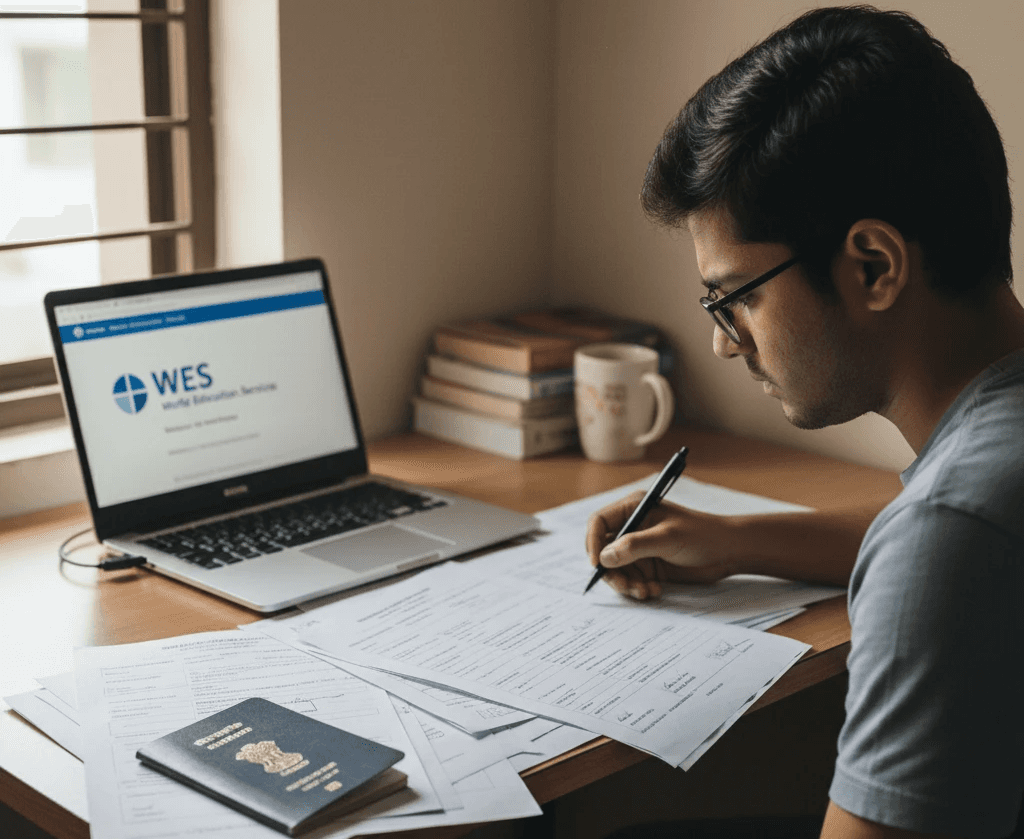
WES stands for World Education Services. Sounds heavy. It’s actually simple.
It takes your Indian academic history and converts it into a format foreign universities and immigration bodies understand. And trust.
Your B.Com.
Your B.Tech.
Your MBA.
Your marksheets.
Your degree.
They aren’t rejected. They’re respected. Just verified first. Foreign institutions don’t run on assumptions. They run on systems. Clear ones. They need structure. Consistency. Proof. That’s where WES steps in. Quietly.
It doesn’t judge your education. It standardizes it. Think of it as a translator. Indian education speaks many dialects. Different universities. Different grading patterns. Different benchmarks. WES turns all of that into one clear academic language that the world recognizes.
Why WES exists, really:
To standardize Indian degrees for global review
To align grading systems across countries
To provide verified academic records
To remove confusion and bring clarity
To help Indian education travel smoothly across borders
Indian education evaluated.
Evaluated, understood.
Understood, accepted.
That’s why WES matters. Not as a hurdle. As a bridge.
Who Actually Needs a WES Evaluation?
Let’s be brutally clear. Not everyone needs WES. And yes, a lot of students burn time and money on it for no reason.WES is not a default step. It’s not a checkbox. It’s a requirement only in specific situations. You apply for it because the system asks for it. Not because someone casually mentioned it.
You need WES when you’re applying for:
Canada PR through Express Entry
Canada PNP programs
Selected Canadian universities
Some U.S. universities
Certain professional or licensing bodies
In these cases, WES isn’t optional. It’s built into the process.
You don’t need WES when:
The university clearly states, “Credential evaluation not required.”
You’re applying to countries that usually accept Indian degrees directly, such as:
UK
Australia
Ireland
The institution already recognizes your Indian qualification
Here’s the smart play. Always confirm this on the official university website. Not forums. Not WhatsApp forwards. Not “my friend’s agent said so.”
Used correctly, WES removes friction. It brings clarity. It keeps your application moving. Apply only when it’s required. That’s how you protect your time, your money, and your momentum.
WES official website – https://www.wes.org
Types of WES Evaluations
I’ll be direct. This is where most students mess up. Not because WES is hard. Because they assume there’s only one type of evaluation. There isn’t.WES works in types. Pick the wrong one, and you don’t fail. You just lose time. And money. And patience. For immigration, especially Canada PR, a Document-by-Document is usually enough. It gives degree equivalency and an overall credential assessment. Clean. Practical. No subject-wise breakup. No GPA math. It does exactly what PR needs. For university admissions and professional licensing, things change. You’ll need Course-by-Course. This one goes deep. Subject analysis. Credit values. GPA conversion. More detail. More accuracy. Also more expensive. And slower. That’s expected. One isn’t better than the other. They serve different goals. Choose based on where you’re applying, not on assumptions. Pick wrong, and you start over. Twice the payment. Same destination.
Quick breakdown that actually matters:
Document-by-Document
Best for: Canada PR, immigration
Includes: degree equivalency, overall assessment
No subject or GPA details
Faster. Affordable. Enough for PR
Course-by-Course
Best for: university admissions, licensing bodies
Includes: subjects, credits, GPA conversion
Detailed. Slower. Higher cost
Required when institutions ask for it
WES isn’t complicated. The decisions are. Make the right one, and everything moves forward smoothly.
WES for Indian Students: Step-by-Step Process
WES starts with an account. Simple step. Not a careless one. You head to the official website and create your profile. That’s it. Or so it looks.
This is where many students quietly slip. Your name must match your passport. Exactly. Same spelling. Same order. No shortcuts. Date of birth. Education history. One small typo here feels harmless now. It isn’t. It shows up later. And fixing it costs time.
Step 1: Create your WES account
Register on the official WES portal
Enter your name exactly as on your passport
Add your date of birth correctly
Fill in education details with care
One spelling error today becomes a delay tomorrow. Next comes the most ignored step. Purpose.
Step 2: Choose the purpose of the evaluation
This part matters more than students think. WES doesn’t assume anything. You choose.
Education
Immigration
Employment
Choose wrong, and everything that follows shifts. The report format. The use case. The money spent. Fixing it later is painful.
Then comes the evaluation type. This is actually simple if you stop overthinking.
Step 3: Select the evaluation type
Canada PR – Document-by-Document
University admission – Course-by-Course
Don’t upgrade just because it sounds premium. Match the requirement. That’s the logic.
Now comes your academic background. Easier than expected.
Step 4: Add your education details
University name
Degree name
Year of completion
Most Indian universities are already listed in WES. If yours isn’t, slow down. Search properly. Select carefully. Rushing here creates clean-looking mistakes that cause real delays later. Do it once. Do it right. That’s how WES stays smooth, predictable, and stress-free.
Transcript Rules for Indian Universities
This is where chaos usually begins. Transcripts.WES has one golden rule. Just one.
Your transcripts must come directly from the institution.
Not from you.
Not from a helpful cousin.
Not from some courier you found last-minute.
Break this rule, and WES doesn’t debate. They reject. Clean and final.
Here’s how WES accepts transcripts:
The university sends transcripts straight to WES
The university uploads them digitally if it’s a WES partner
A sealed envelope sent by the university, with a stamp and signature across the flap
That last detail matters. A lot.If the envelope is open. Even slightly. It’s done. Rejected.
This isn’t WES being harsh. It’s WES protecting authenticity. Follow the rule once, properly, and the process flows. Smooth. Predictable. Miss it, and delays follow. Every time.
Common Indian University Scenarios
Let’s get practical for a moment. Transcript rules aren’t universal. They depend on where you studied. This is where assumptions slow everything down. Most students fall into one of a few common situations. Once you know which one is yours, the process feels lighter. More controlled.
Scenario 1: Autonomous colleges
Here, the college itself issues the transcripts and sends them directly to WES. In many cases, this works well. Fewer layers. Less back-and-forth. Just don’t expect it to move fast every time. Patience helps.
Scenario 2: Affiliated colleges
This is where students usually get stuck. The college alone isn’t enough. The university must issue and send the transcripts. Colleges can guide you, but they don’t hold the final authority.
Common examples:
Anna University
Mumbai University
Osmania University
If you studied under these, the process always runs through the university. Plan for that. It saves frustration.
Scenario 3: Digital transcript universities
Some Indian universities are catching up. A few now support digital transcript sharing with WES. Still limited, but promising.
Examples include:
Anna University (recent updates)
JNTU (selected cases)
Before running from office to office, pause. Check the official WES partner list. It saves time. And energy. Understand your scenario first. That’s how the process stays realistic, steady, and manageable.
How Long Does WES Take?
WES isn’t slow by design. The process around it takes time. Documents in India don’t move overnight. Universities work on their own clocks. Weeks pass. Sometimes more.
Transcript collection alone can stretch from two to six weeks. That’s normal. Once WES receives everything, their review usually takes seven to twenty business days. Put it together, and you’re looking at about one and a half to three months, on a smooth run.
Now, if something slips? A missing seal. Wrong format. One small oversight. The timeline quietly adds another month. Easy. That isn’t bad luck. It’s planning. Or the lack of it. Start early. Build buffer time. Give yourself breathing space. Last-minute applications don’t fail because of fate. They fail because the clock always wins.
WES Fees for Indian Students (Updated Overview)
Let’s keep this real. Costs shift. They always have. They always will. So check the latest numbers before you pay.
Still, here’s the rough picture most students see. A Document-by-Document evaluation usually costs around CAD 220.Course-by-Course costs more. CAD 240 and up, depending on add-ons.Courier charges? Extra. Always. And they pile up faster than expected.
Here’s the part many ignore. WES doesn’t offer refunds. Pick the wrong evaluation. Enter incorrect details. Send the wrong documents. The fee is gone. Clean.
Read that again. Then pause. Slow down before clicking “Pay.”Careful choices here save money later.
GPA Conversion: The Truth No One Tells You
Students obsess over this. Constantly. Will my 60% magically turn into a 3.5 GPA? No. It won’t.WES conversion is conservative. Sometimes painfully honest. A 65% in the Indian system may not look strong on an international scale. That’s reality. Not failure. Not biased. Just standardization is doing its job.
Here’s what most students miss. Universities already know this. They don’t read a WES report in isolation. They read context. Your university. Your program. Your trajectory. Your full profile. Numbers matter, yes. They aren’t everything.
So stop stressing over figures you can’t change. Redirect that energy. Work on your SOPs. Build real experience. Show clarity and intent. That’s where decisions shift. That’s where outcomes improve.
Typical Errors Made by Indian Students
Learn from others. Not from your own mistakes. Most WES errors are predictable. Simple. And expensive.
Mistake 1: Sending attested marksheets
This trips people up every time. WES doesn’t accept:
Notary attestations
College stamps alone
Self-attested copies
They want official transcripts. Direct from the institution. Sealed. Signed. Clean.
Mistake 2: Name mismatch
Passport says: Prasanna Kumar
Degree says: Prasanna K
Looks minor. It isn’t. Fix it early. Use an affidavit if needed. One small mismatch can stall the entire process.
Mistake 3: Wrong evaluation type
Immigration applicants choosing Course-by-Course instead of Document-by-Document. Classic error. Costs more. Adds nothing.
Follow the rules once. Double-check before you submit. You save time. You save money. You stay calm.WES feels simple when you learn from mistakes that others have already paid for.
WES vs Other Credential Evaluation Bodies
WES is popular. That’s it. Not exclusive. It works for many cases. Not all.
There are alternatives:
IQAS
CES
ICAS
PEBC (for pharmacy programs)
Some immigration pathways accept these. Some universities do too. Others stick strictly to WES. No flexibility. So don’t assume. Always check the official requirement list for your program or application. One quick verification saves weeks later. Choose what fits your path, and the process stays smooth.
Does WES Expire?
Yes. WES reports have a lifespan. Five years, to be exact.After that? You might need a re-evaluation. For Canada PR applicants, this matters. Especially at the time of profile creation. Check dates. Plan. Don’t let expired reports block your progress.WES isn’t permanent, but it’s predictable. Use it smartly. Keep momentum.
Is WES Mandatory for Studying Abroad?
Stop assuming. That’s where students lose time.WES isn’t required for every university. Or every case. Many institutions handle evaluations internally. Many accept Indian degrees as they are. Clean. Direct. No extra steps. No added cost.
Think of WES as a tool. A helper. Not a rulebook. Use it when the requirement is clear. Skip it when it isn’t needed. Simple logic . Understand the system first. Read instructions properly. Match the process to your situation. When you do that, everything feels lighter. More controlled. That’s how the study abroad journey stays simple, focused, and stress-free.
Palanivel Overseas Education: WES Fees for Indian Students
Let’s talk numbers. And support. Because WES isn’t just paperwork—it’s money, time, and stress if done wrong.
WES Fees (Approximate):
Document-by-Document: CAD 220
Course-by-Course: CAD 240+
Courier charges: extra, varies by country
This is where Palanivel Overseas Education steps in. They don’t just tell you what WES costs. They make sure you spend it smartly.
How they help:
Guidance on choosing the right evaluation type for your application
Step-by-step support for WES account creation and profile setup
Assistance with university-specific transcript processes
Verification before submission to avoid errors
The result? Students save time, money, and most importantly, stress. One clean process. Done right. No last-minute panic. No wasted fees.